
Can you clean your own dryer vent?
Partly, and it is worth doing. You can reach the lint screen housing, the space behind the machine, and the flexible hose. What you cannot reach is the part inside the wall, which is where the blockages that cause trouble actually form. Knowing which half you have handled is the whole question.
The short version
- check_circleThe lint screen, its housing, the cavity behind the dryer and the flexible transition hose are all genuinely DIY.
- check_circleThe duct inside the wall is not. Code allows a run up to 35 feet, minus 5 feet for every 90 degree bend, and most of it is not reachable from either end.
- check_circleThe exterior hood and its damper flap need to come off the wall to be checked properly.
- check_circleYou cannot confirm the result by eye. Samsung dryers only trigger their own vent warning at roughly 60 percent blocked.
What can you actually do on your own?
More than most companies will admit. None of this needs a professional:
- check_circleClear the lint screen every single load, not every few
- check_circleVacuum inside the lint screen housing, which collects far more than people expect
- check_circlePull the dryer out and clean the cavity behind it
- check_circleDisconnect the flexible transition hose and clear it through
- check_circleGo outside, run the dryer, and check the hood flap actually lifts
Done once or twice a year, that genuinely helps. It is also the cheapest maintenance in your house.
What can you not reach?
The duct inside the wall, which is the part that matters. Under the 2021 International Residential Code a dryer duct can run up to 35 feet, and each 90 degree elbow costs another 5 feet of that allowance. A run with three bends is effectively limited to 20 feet, and every one of those feet is behind drywall.
Blockages form at the bends and at the exterior termination, not at the two ends you can see. A shop vacuum pulls from the opening and leaves the rest, which is why a vent can look clear at both ends and still be packed in the middle.
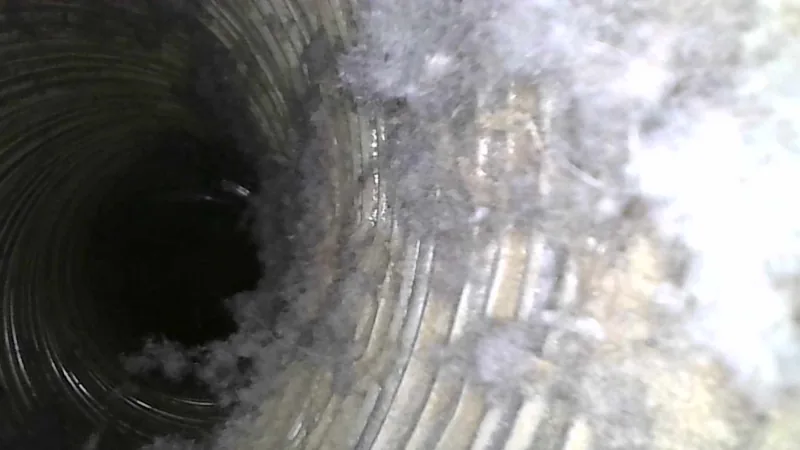
There is also the transition hose to get right. The code requires a listed UL 2158A transition duct, no longer than 8 feet, and it must never be concealed inside a wall. Vinyl and plastic hose is not approved, and Toronto Fire Services is blunt that it ignites.
Why does the exterior hood matter so much?
Because it is where the lint arrives last and stops moving. The hood carries a damper flap that airflow pushes open and gravity pulls shut, and when that flap seizes with lint, gets painted over or is propped open, everything changes at once. Airflow drops, and animals get an entry point.
Checking it properly means taking the hood off the wall, not looking at it from the lawn. That is the step almost nobody does at home, and it is the step that tends to find the problem.
One thing not to do: never fit a screen or mesh over the termination. Building code prohibits it, and dryer manufacturers say the same in their own manuals.
How do you know if what you did was enough?
Honestly, you usually cannot, and this is the strongest argument against relying on DIY alone. You cannot see into the wall and you have no way to measure the airflow before and after.
Your dryer is not much help either. Samsung dryers carry a vent blockage warning light, and it only triggers at roughly 60 percent blocked. By the time the machine tells you, most of the duct is already gone.
The practical test is the laundry itself. If a normal load still needs a second cycle after you have cleaned everything you can reach, the restriction is in the part you cannot.

What you can clean yourself, and what you cannot
Cleaning your own dryer vent is half possible. The lint screen, its housing, the cavity behind the machine and the flexible transition hose are all reachable with a vacuum and half an hour. Do them regularly and you will be better off than most households.
The duct inside the wall is the other half. Code permits runs up to 35 feet with 5 feet deducted per bend, blockages form at the elbows and the termination rather than the ends, and the exterior hood has to come off the wall to be checked. You also have no way to verify the result, and your dryer will not warn you until it is around 60 percent blocked.
NestFlo does dryer vent cleaning in Burlington, Hamilton, Oakville, Mississauga, Milton, Waterdown, Georgetown and Stoney Creek, at a flat $199, or $179 for a first cleaning.
Common questions about DIY dryer vent cleaning
Do the dryer vent cleaning kits from hardware stores work?
They help on short straight runs and they are better than doing nothing. On a run with several bends they tend to push lint along rather than remove it, and they give you no way to check the result or to inspect the exterior hood and flap.
How often should a dryer vent be cleaned?
The manufacturers do not fully agree. Whirlpool says every one to two years, Samsung Canada says once or twice a year, and the NFPA says annually. Households drying more laundry, or with a long duct and several bends, sit at the frequent end.
Can I use a leaf blower to clear my dryer vent?
It moves loose lint but it does not remove packed lint, which is the kind that causes problems. It also pushes debris further into the run, and it does nothing about a seized damper flap at the hood.
Is a flexible plastic dryer hose acceptable?
No. The code requires a listed UL 2158A transition duct, no more than 8 feet long and never concealed in a wall. Vinyl and plastic hose is not approved, and Toronto Fire Services warns that it ignites.
Which areas does NestFlo cover?
Burlington, Hamilton, Oakville, Mississauga, Milton, Waterdown, Georgetown and Stoney Creek. Just outside those? Ask anyway, and if we can reach you we will say so honestly.